
本文由 goa大象设计授权mooool发表,欢迎转发,禁止以mooool编辑版本转载。
Thanks GOA for authorizing the publication of the project on mooool, Text description provided by GOA.
goa大象设计:“木守·朱泾从在地的湿地地貌与民居类型出发,尝试将传统中关于气候、尺度、身体和聚落的空间机制重新激活。场所成为一种追问:当下的建筑如何回应土地的记忆?人如何重获对自然和自身的感知?”
——张晓晓 木守·朱泾 主持建筑师
GOA: “Beginning with the wetland terrain and local housing typologies, Muh Shoou Zhujing seeks to reactivate the spatial mechanisms embedded in tradition—those related to climate, scale, the body, and settlement. The site thus becomes a question in itself: How can architecture respond to the memory of the land? How might people recover their perception of nature and of themselves?”
— Shawn Cheung, Lead Architec tof Muh Shoou Zhujing
▽项目视频
▽水杉、浮岛与客房 ©一哒

在上海建造一座度假酒店,最易期待的位置,或许是黄浦江边某处被城市记忆反复确认的街区。然而,木守·朱泾重新提出了一个关于上海的问题:现代都市的明亮表面之下,是否还存在一条更深远也更贴近乡土的根脉?它给出的回答,是让建筑伏低,水网展开,树木生长,让空间重新回到贴近身体与自然的尺度之中。
从市中心向西南,进入金山区朱泾镇一片被水网与田园包围的土地,是一次对城市历史的追溯:在成为今日的大都市前,上海曾经也是由水定义的土地。浦、港、浜、泾,这些反复出现在地名中的字,在沧海桑田的城市版图中记录了河流、水道与湿地组织生活的方式。
To build a resort hotel in Shanghai, the most expected location might be a site along the Huangpu River, within an urban district repeatedly affirmed by the city’s modern memory. Yet Muh Shoou Zhujing opens a different question about Shanghai: beneath the luminous surface of the metropolis, does there remain a deeper root, one more closely tied to the countryside? The project’s answer is to let architecture stay low, waterways unfold, and trees grow freely, returning space to a scale close to the body and to nature.
Traveling southwest from the downtown to Zhujing Town, Jinshan District, one enters a landscape surrounded by waterways and farmland. It is also a journey back through the city’s history. Before Shanghai became the metropolis it is today, it was a land defined by water. Characters such as pu(浦), gang(港), bang(浜), and jing(泾), which recur throughout local place names, record how rivers, creeks, and wetlands once structured everyday life across the region.
01 寻找“另一个”上海
朱泾所在的金山、松江、青浦一带,延续了江南水乡的农耕传统。地质学意义上的“古冈身带”——一条由贝壳砂堤与古海岸线形成的自然高地,贯穿上海西南部。相比低洼的湿地,略高于周边水面的冈身地带更适合定居耕种,因此成为早期聚落与市镇形成的基础。朱泾正位于古冈身附近,“泾”字即意为纵横水网中的河道支流。
The area where Zhujing is located continues the agricultural traditions of the Yangtze Delta water towns. In geological terms, the Gangshen belt—a natural ridge formed by shell-sand embankments and ancient shorelines—runs through the southwestern part of Shanghai. Compared with the low-lying wetlands, this slightly elevated terrain was more suitable for settlement and cultivation, and therefore became the foundation for early villages and towns. Zhujing lies near this ancient ridge; the character jing(泾) refers to a branch stream within an water network.
▽由酒店遥望朱泾镇天际线 ©一哒

水运、集镇、农田与手工业的长期层累,使朱泾保留了一种不同于近代上海的江南集镇气质:缓慢、贴近土地,更接近水乡聚落的历史原型。朱泾之所以成为木守品牌第二家酒店的选址,不仅因为远离市区、接近自然,也因为它指向一种常被遮蔽的历史深度。来到朱泾,意味着回到一个易被忽略的“上海之前的上海”。
对设计团队而言,这种“原乡”应当超越图像符号的怀旧或风物陈列,成为关于聚落尺度与身体感知的整体设计问题:65间别墅式套房散落于花海、水杉林与河道间,基于“寻根原乡秘境”的愿景,建筑师试图把乡土生活与当代度假体验重新编织。
Through the accumulation of water transport, market-town life, farmland, and handicraft production, Zhujing has retained a market-town character distinct from that of modern Shanghai: slower, closer to the land, and more aligned with the historical prototype. The choice of Zhujing as the site for Muh Shoou’s second hotel was not simply a matter of distance from the city or proximity to nature. More importantly, it points to a historical depth that is often obscured. To arrive in Zhujing is to return to a frequently overlooked “Shanghai before the metropolis.”
For the designers, this sense of origin should move beyond nostalgic imagery or the display of local motifs. Instead, it becomes a broader design question concerning settlement scale and bodily perception. Sixty-five villa-style suites are scattered among flower fields, dawn redwood groves, and waterways. Based on the vision of creating a secluded retreat in search of origins, the architects sought to reweave rural life and contemporary resort experience.
▽建筑、步道与视线转折 ©一哒

在这个意义上,木守·朱泾的设计过程与其说是在郊野中建一座奢华酒店,更像是“如何在都市之外重新发现都市的来处”。
In this sense, the design of Muh Shoou Zhujing is less about building a luxury hotel in the countryside than about asking how the origins of the city might be rediscovered beyond the city itself.
▽场地鸟瞰 ©一哒

02 水网之间,村落生长
项目的平面空间结构以三个层次展开:西北侧展开落客、停车与后勤区域;中部集中布置大堂、餐厅、宴会厅与泳池等公共功能;东南侧则为低密度的客房组团。公共界面相对集中,客房区域则呈散点式分布,二者之间通过水院、步道与植物群落完成过渡。
The site plan is organized in three layers. The northwest side accommodates drop-off, parking, and back-of-house areas. The central zone contains the hotel’s public functions, including the lobby, restaurant, banquet hall, and swimming pool. The southeast side is composed of low-density guestroom clusters. The public interface is relatively concentrated, while the guestroom area is dispersed; between the two, water courtyards, pathways, and plant communities form a gradual transition.
▽联结公共区域的回廊与半透明界面 ©一哒


这种布局起初是对点状供地政策的回应。分散的建设用地使建筑无法连续铺展,却也让每一组客房天然获得了“岛”的属性。建筑、庭院、水岸与植物共同构成一个最小居住单元;多个单元再通过水体、路径与视线相互关联,形成一种介于单体与聚落之间的场地秩序。
水体在平面布局中承担了多重角色。它取代了生硬的围墙,划分公共区域的功能边界;它组织步行体验,让抵达客房的路径曲折化为连续游走;它调节客房之间的距离,通过水面归置植物位置与建筑错动,形成柔和的边界;它也延续了湿地的地理记忆,使场地从后天形成的花海和苗圃等人工造物,转向水网、岛屿与乡土植物共同作用的自然生态结构。
This layout was initially a response to the local policy of allocating construction land as discrete points rather than continuous plots. The fragmented land parcels prevented the buildings from extending as a single continuous fabric, but they also allowed each guestroom cluster to acquire the character of an “island.” Architecture, courtyard, waterfront, and planting together form the smallest unit of inhabitation. Multiple units are then linked through water, paths, and views, producing a site order between the individual building and the settlement.
Water plays multiple roles in the plan. It replaces hard enclosure walls and defines functional boundaries within the public zone. It organizes the pedestrian experience, turning the route to each guest room into a continuous, meandering walk. It regulates the distance between rooms, using water surfaces, planting, and staggered building positions to create gentle boundaries. It also extends the geographical memory of the wetland, transforming a site previously shaped by man-made flower fields and nurseries into an ecological structure composed of waterways, islands, and local vegetation.
▽水杉环绕中的客房组团 ©一哒

在此基础上,景观设计被视作布局生成的前提。水杉、柳树、楝树等乡土植物被组织在水岸、道路和院落边界中,塑造场地的竖向层次,也参与了尺度控制。树冠逐渐长成之后,建筑将“隐入”林下。所谓湿地村落,并非一种风格化的想象,而是在功能、交通、水位、植物特征与客房私密性之间逐步推导出的结果。
Landscape design was treated as a precondition for the generation of the layout. Native plants such as dawn redwoods, willows, and chinaberry trees are arranged along water edges, roads, and courtyard boundaries, shaping the site’s vertical hierarchy while also participating in the control of scale. As the tree canopies mature, the buildings will gradually recede beneath the woodland. The idea of a wetland village is therefore not a stylistic imagination, but the result of a step-by-step negotiation among function, circulation, water levels, planting characteristics, and guestroom privacy.
▽植物群落 ©一哒


03 再造地方民居
项目对地方传统的回应首先来自类型学层面的辨析。建筑师并未把“江南民居”作为一个笼统的地域风格处理,而是进一步追问:在上海西南部的水乡环境中,传统民居究竟通过哪些空间机制回应气候、地形、材料与聚落生活?
建筑师踏勘过程中发现的“落戗屋”与“绞圈房”成为设计关注的两种原型。落戗屋是江南地区,特别是沪郊一带传统民居中常见的屋顶形式,其特征是屋面坡度舒缓、四角落戗,向下延展,形成低伏的大屋顶。由于东南沿海长期处于高湿、多雨的气候环境中,这种屋面能够迅速排水,并通过深远出檐保护墙体,减少侵蚀。低檐同时压低了建筑重心,使房屋在水乡环境中呈现出一种稳定的姿态,也让室内获得适合日常起居的尺度。
The project’s response to local tradition begins with typological analysis. Rather than treating “Jiangnan dwellings” as a generalized regional style, the architects asked a more specific question: within the water-town environment of southwestern Shanghai, through what spatial mechanisms did traditional dwellings respond to climate, terrain, materials, and settlement life?
During their field research, the architects identified Luoqiang houses and Jiaoquan houses as two key prototypes. Luoqiang houses are a common roof type in traditional Jiangnan dwellings, especially in the suburbs of Shanghai. They are characterized by gently sloping roof planes and turned-down corners, which extend downward to form a broad, low-lying roof. In the humid and rainy climate of the southeastern coast, this roof form allows rainwater to drain quickly, while its deep eaves protect the walls from erosion. The low eaves also visually lower the building’s center of gravity, giving the house a stable presence within the water-town landscape and creating an interior scale suited to everyday life.
▽结合落戗屋与歇山顶特征的屋顶 ©goa大象设计
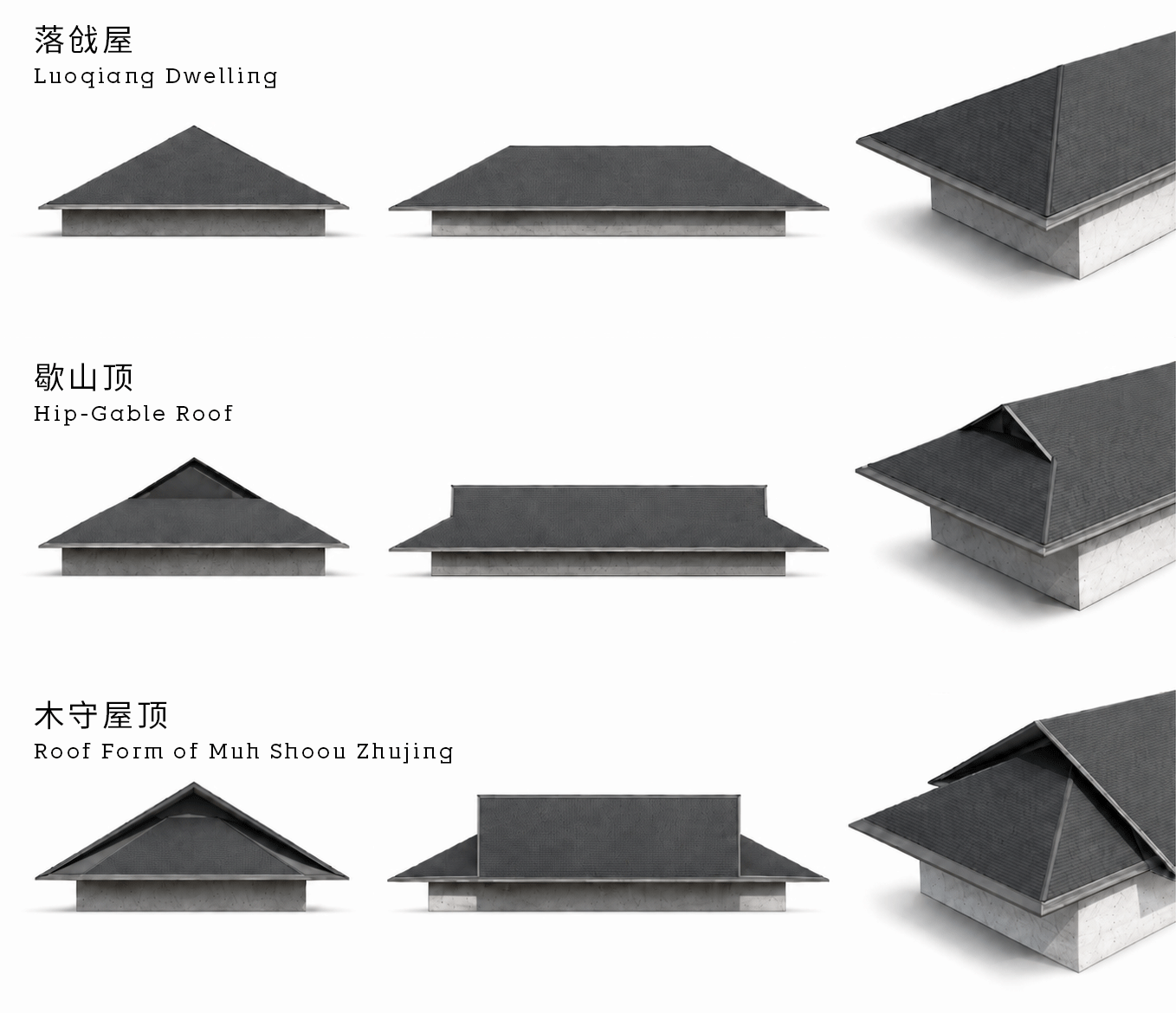
▽结合落戗屋与歇山顶特征的屋顶 ©一哒

“绞圈房”则是一种聚落组织方式,通常由多个房间、院落与附属空间围绕天井连续围合,形成紧密的空间网络。这种布局回应了农村地区的有限宅基地条件,也适应家族聚居与生产生活混合的需求:不同体量之间通过檐廊、过道和院墙彼此连接,在遮风避雨的同时形成半开放的公共交往空间。
Jiaoquan houses, by contrast, refer to a mode of settlement organization. They are typically formed by multiple rooms, courtyards, and ancillary spaces arranged continuously around a patio, creating a compact spatial network. This layout responded to the limited homestead conditions of rural areas, while also accommodating family-based dwelling and the overlap of production and daily life. Through eaves, corridors, passages, and courtyard walls, different volumes are connected to one another, providing shelter from wind and rain while producing semi-open spaces for everyday social exchange.
▽深远出檐下的灰空间 ©TOPIA图派视觉

▽深远出檐下的灰空间 ©一哒


04 贴近身体的尺度
项目精细的尺度控制由平面布局延续至室内空间。人在场地中移动时,面对的不是开阔景观的一次性展开,而是近水、转折、遮蔽、再显现的连续变化。小半径路径、低矮院墙、贴近窗边的绿意,共同限定了一种适宜步行、停留和回望的身体尺度。
The project’s careful control of scale extends from the plan into the interior spaces. As one moves through the site, the landscape does not unfold as a single panoramic view. Instead, the experience is composed of a continuous sequence: proximity to water, turns, concealment, and reappearance. Paths with small turning radii, low courtyard walls, and greenery placed close to windows together define a bodily scale suited to walking, pausing, and looking back.
▽曲折步道与转角视线 ©一哒


公共区域高度控制在约2.4米的低檐口,则是尺度体系在建筑剖面上的集中表达。檐口高度控制回应了落戗屋低伏屋顶、深远出檐的范式,横向展开的玻璃界面使室内视线贴近地面。檐口被压低后,建筑并不追求以高度取得存在感,而是以屋顶水平延展投射的灰空间建立场所气质。
同时,低檐并不意味着空间单一地向下压缩,坡屋顶的形态允许室内层高向上拓展。人在进入空间时,观感先被檐口收束,随后感受到屋顶上扬带来的释放。地面局部下沉至室外地坪之下,进一步强化了这种感受,使空间带有船舱般的包裹性。
In the public areas, the eave height is controlled at approximately 2.4 meters, becoming a concentrated expression of this scale system in section. The low eaves respond to the paradigm of the Luoqiang house, with its low-lying roof and deep overhangs, while horizontally extended glass interfaces keep interior views close to the ground. Once the eaves are lowered, the building no longer seeks presence through height. Instead, it establishes the character of the place through the semi-outdoor transitional spaces projected by the roof’s horizontal extension.
At the same time, low eaves do not mean that space is simply compressed downward. The pitched roof allows the interior height to rise upward. Upon entering, one’s perception is first gathered and compressed by the eaves, then released by the upward lift of the roof. In certain areas, the floor is sunken below the exterior ground level, further intensifying this experience and giving the space a boat-cabin-like sense of enclosure.
▽如船舱般的空间观感 ©一哒


室内设计则以木、石、纸、织物与带有手作痕迹的表面,延续了建筑低伏、内敛的气质。帘幕与屏风将透明玻璃转化为可调节的界面,使光影在室内形成若隐若现的层次。建筑、景观与室内共同把度假空间从宏大景观的观看逻辑,转向贴近身体的感知逻辑。
The interior design continues the architecture’s low-lying and restrained character through wood, stone, paper, textiles, and surfaces bearing traces of handcraft. Curtains and screens transform transparent glass into adjustable interfaces, allowing light and shadow to form subtle, shifting layers indoors. Together, architecture, landscape, and interior design shift the resort experience away from the logic of viewing a grand landscape and toward a sensory logic close to the body.
▽室内材料、光影与艺术陈设 ©一哒


▽室内材料、光影与艺术陈设 ©TOPIA图派视觉

客房是酒店聚落结构中的最小单元。每组客房都拥有独立庭院,与室内空间共同构成完整的居住场景,其基本关系可以概括为“一房、一院、一岛”:房间提供庇护,院落调节私密与开放,水面和植物则将客房纳入更大的湿地环境。
延续木守品牌对“中国式待客之道”的理解,客房内部的茶寮提供了饮茶、对谈、阅读与休憩的场所,也成为人与庭院发生联系的界面。水、院与茶寮共同构成松弛而有秩序的生活场景,也让每一间客房成为湿地聚落中的一个独立居住单元。
The guest room is the smallest unit within the hotel’s settlement structure. Each guestroom group has its own courtyard, forming a complete living scene together with the interior space. This basic relationship can be summarized as “one room, one courtyard, one island”: the room provides shelter, the courtyard mediates between privacy and openness, and the water surface and planting connect the guest room to the larger wetland environment.
Continuing Muh Shoou’s understanding of Chinese hospitality, the tea room inside each guest room provides a place for tea drinking, conversation, reading, and rest. It also becomes the interface through which guests connect with the courtyard. Water, courtyard, and tea room together create a relaxed yet ordered scene of living, allowing each guest room to become an independent dwelling unit within the wetland settlement.
▽客房场景 ©TOPIA图派视觉

▽客房场景 ©一哒

技术图纸
▽总平面图 ©goa大象设计

▽公区一层平面图©goa大象设计

▽客房立面图 ©goa大象设计

▽泳池吧与健身房立面图 ©goa大象设计

项目名称:木守·朱泾
项目地点:上海市金山区
设计/竣工:2021/2026
建筑面积:9,800㎡
业主:上海木守朱泾酒店有限公司
建筑设计:goa大象设计
景观设计:张唐景观
室内设计:春山秋水
灯光顾问:PROL光石
摄影:一哒、TOPIA图派视觉
Project Name: Muh Shoou Zhujing
Location: Jinshan, Shanghai
Design/Completion: 2021 / 2026
Floor Area: 9,800 m2
Client: Shanghai Muh Shoou Zhujing Hotel Co., Ltd.
Architectural Design: GOA
Landscape Design: Z+T Studio
Interior Design: Nature Times Art Design
Lighting Consultant: PROL
Photographer: Yida, TOPIA Vision
“ 一座重回自然的酒店。”
审稿编辑:Maggie
更多 Read more about: goa大象设计


0 Comments